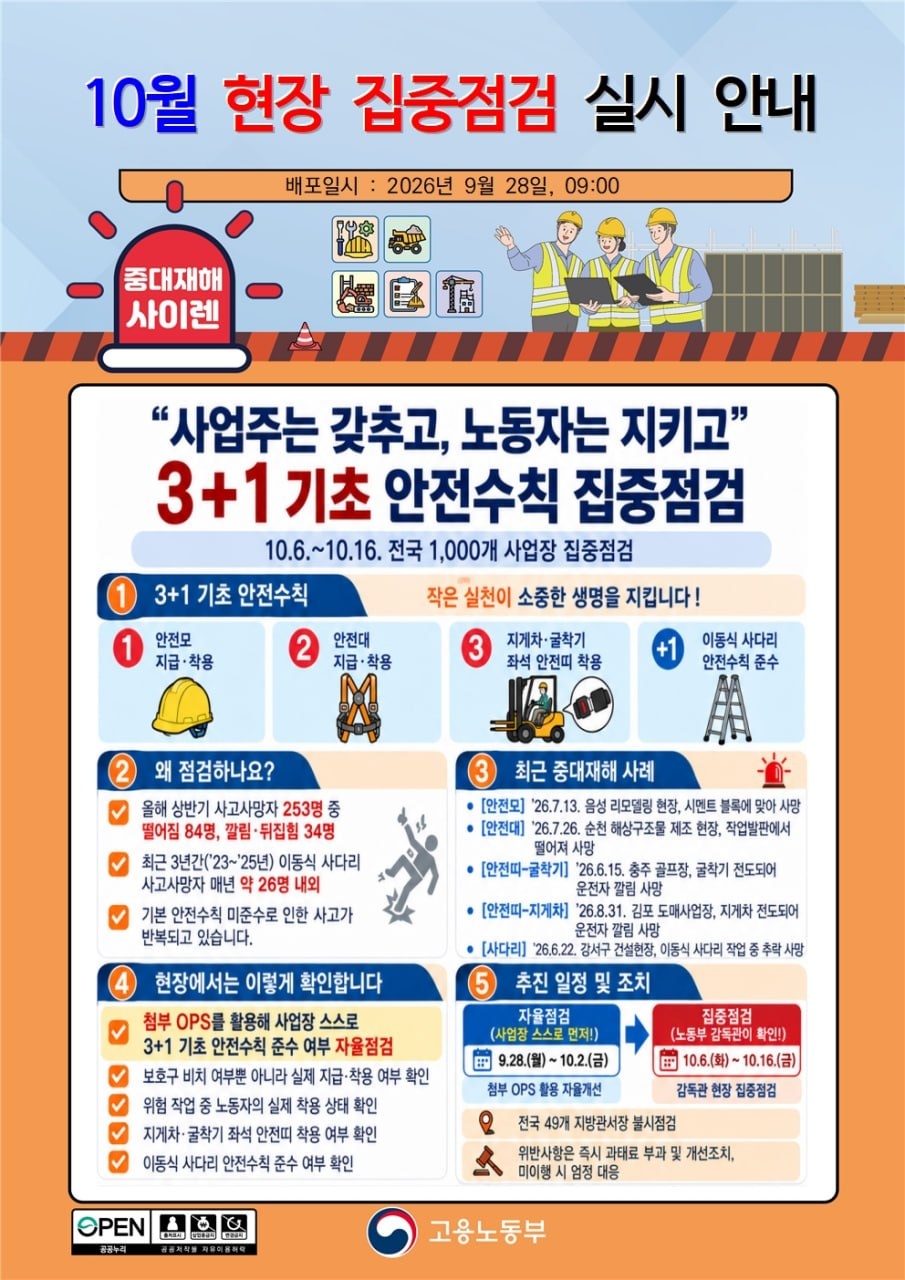
불씨보다 먼저 보아야 할 것
화재·폭발사고 예방은 작업 전의 작은 확인에서 시작된다
화재·폭발 예방은 사고 이후의 대응보다, 인화성 물질·점화원·정전기·화재위험작업을 사전에 끊어내는 현장의 확인체계에서 출발한다.
Before the Spark Appears
Fire and Explosion Prevention Begins With Small Pre-Work Checks
Fire and explosion prevention starts not with emergency response, but with the daily discipline of controlling flammable materials, ignition sources, static electricity, and hot work conditions before work begins.
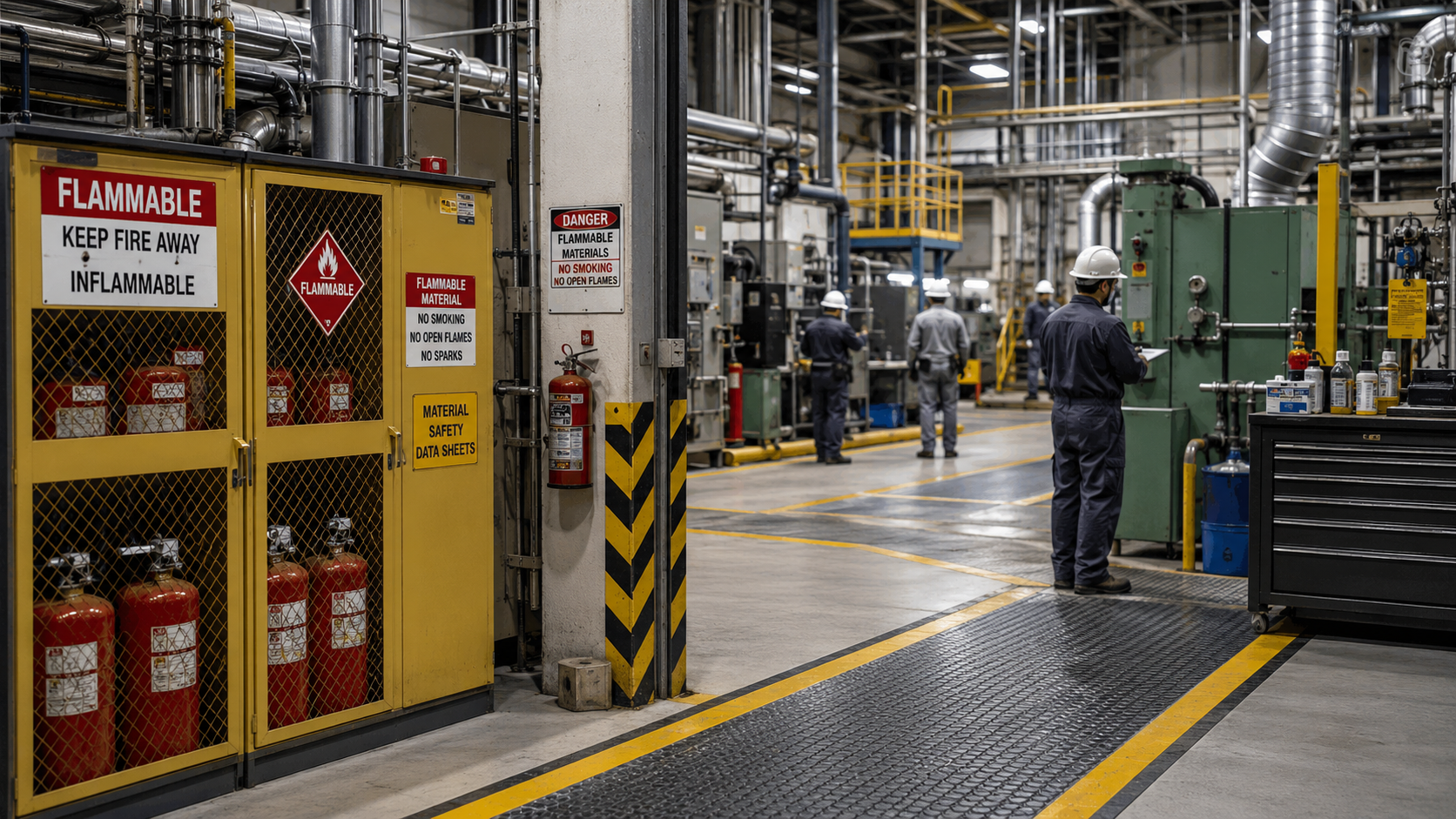
공장 안의 통로는 늘 비슷한 모습으로 하루를 시작한다. 비상구 표지는 초록빛으로 켜져 있고, 소화전함과 소화기는 지정된 위치에 놓여 있으며, 작업자들은 익숙한 동선을 따라 설비와 자재 사이를 이동한다. 겉으로 보기에는 정돈된 현장이지만, 화재·폭발 위험은 언제나 눈에 띄는 불꽃에서 시작되는 것이 아니라 인화성 액체의 증기, 분리되지 않은 점화원, 충분하지 않은 환기, 잠시 미뤄진 전원 차단처럼 조용한 조건 속에서 자라난다.
화재·폭발사고 예방의 핵심은 사고가 발생한 뒤 빠르게 대응하는 데만 있지 않다. 더 중요한 것은 불이 붙기 전, 폭발 분위기가 형성되기 전, 작업자가 위험을 체감하기 전 단계에서 위험의 조건을 끊어내는 일이다. 인화성 물질이 있는 장소에서 가스농도를 측정하고, 충분한 환기를 실시하며, 화기 사용을 제한하고, 정전기와 전기적 이상을 관리하는 일은 모두 하나의 목적을 향한다. 현장에서 불이 날 수 있는 조건을 만들지 않는 것이다.
화재·폭발 예방은 소화기 앞에서 시작되지 않는다. 불이 붙을 조건을 만들지 않는 작업 전 확인에서 시작된다.
A factory corridor often begins the day with a familiar appearance. Emergency exit signs glow in green, hose cabinets and fire extinguishers stand in designated locations, and workers move between equipment and materials along the routes they know well. At first glance, the workplace may look orderly, but fire and explosion risks do not always begin with a visible flame. They often grow quietly in conditions such as flammable vapor, an ignition source that has not been separated, insufficient ventilation, or power that remains connected after use.
The essence of fire and explosion prevention is not limited to responding quickly after an incident occurs. More important is to interrupt the conditions of danger before ignition, before an explosive atmosphere forms, and before workers experience the risk directly. Measuring gas concentration where flammable substances may exist, securing adequate ventilation, restricting open flames, and managing static electricity and electrical abnormalities all point toward one objective: preventing the workplace from creating conditions in which fire can start.
Fire and explosion prevention does not begin in front of a fire extinguisher. It begins with pre-work checks that prevent ignition conditions from forming.
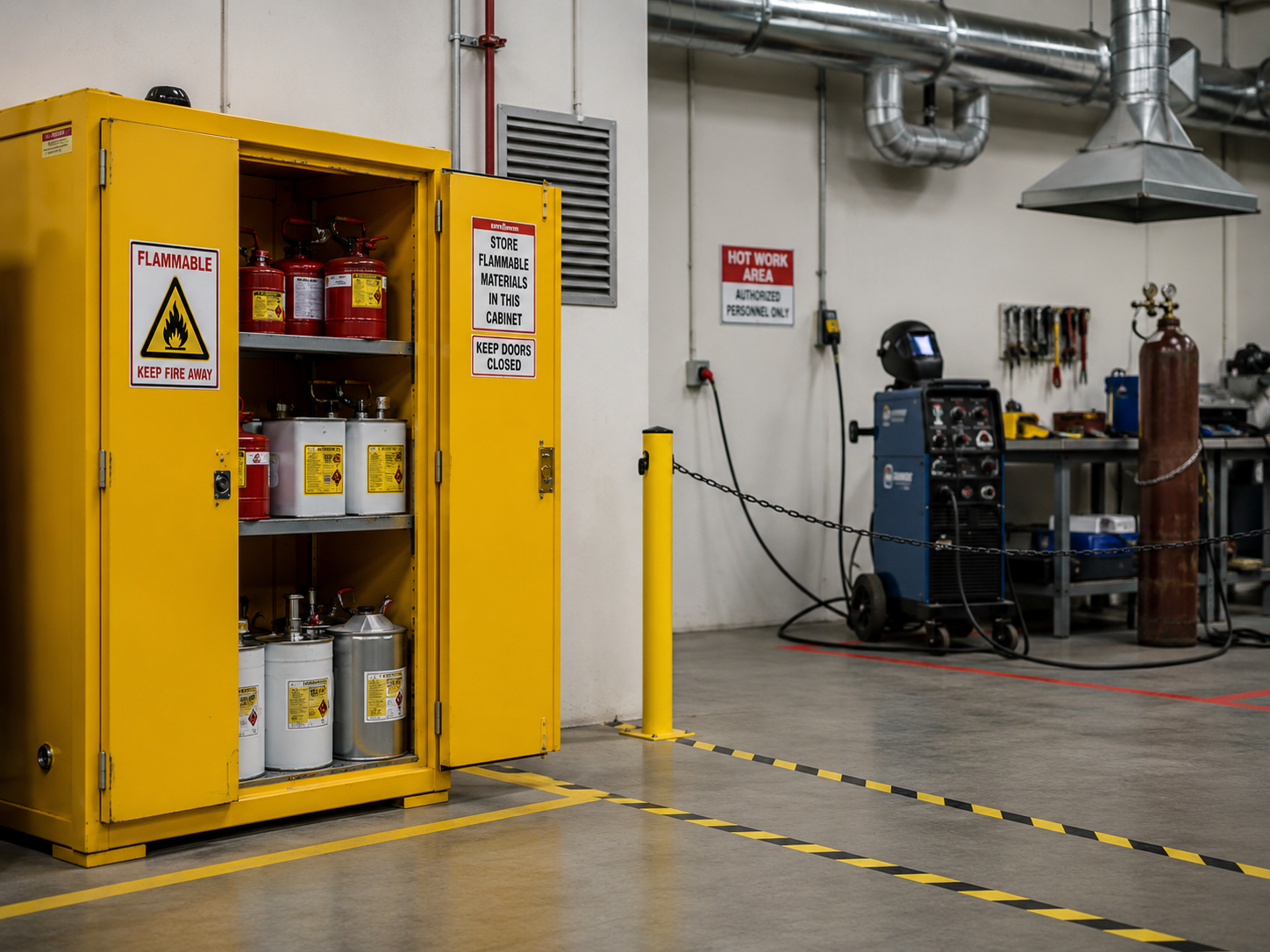
위험은 물질과 점화원이 만나는 순간 커진다
화재·폭발 위험을 이해하려면 먼저 물질과 점화원의 관계를 보아야 한다. 인화성 액체, 가연성 물질, 가스, 분진은 각각의 형태는 다르지만, 일정한 조건에서 공기와 섞이고 점화원과 접촉하면 순식간에 화재나 폭발로 이어질 수 있다. 따라서 현장에서 중요한 것은 위험물질을 단순히 보관하고 있다는 사실이 아니라, 그 물질이 어떤 장소에 놓여 있고, 주변에 어떤 점화원이 있으며, 환기와 차단이 어떻게 이루어지고 있는지를 함께 확인하는 일이다.
가연성·인화성 물질 주변에서 흡연이나 화기 사용을 금지하는 것은 가장 기본적인 조치이다. 그러나 실제 현장에서는 노골적인 불꽃보다 더 작은 점화원이 문제를 만든다. 누전이나 과전류가 발생한 전기기계·기구, 과열된 난방기구, 접지가 불량한 설비, 정전기가 축적되는 용기와 배관, 작업 후 꺼지지 않은 전원은 모두 화재의 출발점이 될 수 있다. 화재 예방은 “불을 쓰지 않는다”는 단순한 문장으로 끝나지 않고, 점화원이 될 수 있는 모든 조건을 식별하고 격리하는 관리로 확장되어야 한다.
특히 인화성 액체 증기 등이 존재할 수 있는 장소에서는 작업 전 가스농도 측정과 환기가 필수적인 예방 절차가 된다. 눈에 보이지 않는 증기는 작업자의 감각으로만 판단하기 어렵고, 환기가 충분하지 않은 공간에서는 작은 점화원만으로도 위험이 급격히 커질 수 있다. 이때 가스농도 측정, 환기, 화기 차단, 정전기 제거는 각각 별개의 조치가 아니라 하나의 연속된 방어선으로 작동한다.
화재·폭발 위험은 물질 하나로 완성되지 않는다. 위험물질, 공기, 점화원, 관리공백이 만나는 순간 사고의 조건이 만들어진다.
정전기와 전기는 가장 조용한 점화원이다
작업장에서는 눈에 보이는 불꽃보다 눈에 보이지 않는 점화원이 더 관리하기 어렵다. 정전기는 마찰과 이동, 충전과 방전의 과정에서 발생하며, 인화성 증기나 가연성 분진이 존재하는 환경에서는 작은 방전도 위험한 점화원이 될 수 있다. 따라서 인화성·가연성 물질을 취급할 때는 가습, 제전장치, 도전성 재료 사용, 접지와 본딩 같은 조치를 통해 정전기의 발생과 축적을 억제해야 한다.
전기설비도 마찬가지이다. 누전차단기와 과전류차단장치는 단순한 부속설비가 아니라 전기적 이상이 화재로 이어지는 것을 막는 기본적인 안전장치이다. 그러나 설치 자체만으로 충분하지 않으며, 차단기의 작동상태, 전선 피복 손상, 임시배선 사용, 콘센트 과부하, 난방기구 사용 후 전원 차단 여부까지 함께 관리되어야 한다. 전기화재는 대개 조용히 시작되기 때문에, 관리되지 않은 작은 이상이 어느 순간 연기와 열로 드러난다.
현장에서는 “잠깐 쓰는 전기기구”나 “임시로 연결한 배선”이 장기간 방치되는 경우가 있다. 처음에는 작업 편의를 위한 선택이지만, 시간이 지나면 그것이 현장의 정상상태처럼 굳어진다. 안전관리자는 이러한 임시조치가 반복되는 지점을 확인하고, 전기기계·기구의 과열 가능성과 차단장치의 관리상태를 점검해야 한다. 화재 예방에서 임시는 오래될수록 위험해진다.
보이지 않는 점화원은 보이지 않는 만큼 더 체계적으로 관리되어야 한다. 정전기와 전기적 이상은 조용하지만 강력한 화재의 출발점이다.
Risk Grows When Materials and Ignition Sources Meet
To understand fire and explosion risk, it is necessary to look first at the relationship between hazardous materials and ignition sources. Flammable liquids, combustible materials, gases, and dusts appear in different forms, but under certain conditions they can mix with air and ignite rapidly when they encounter an ignition source. What matters in the field is therefore not only that hazardous materials are stored, but where they are located, what ignition sources exist nearby, and how ventilation and separation are actually maintained.
Prohibiting smoking or open flames around flammable and combustible materials is one of the most basic controls. Yet in real workplaces, smaller ignition sources often create greater difficulty than obvious flames. Electrical equipment with leakage or overcurrent, overheated heaters, poorly grounded facilities, containers and piping that accumulate static electricity, and power left on after work can all become starting points of fire. Fire prevention must therefore move beyond the simple instruction of not using flame and expand into identifying and isolating every condition that can become an ignition source.
Where flammable vapors may exist, pre-work gas concentration measurement and adequate ventilation become essential preventive procedures. Invisible vapor cannot be judged reliably by human senses alone, and in spaces with insufficient ventilation even a small ignition source can rapidly increase the risk. In that situation, gas measurement, ventilation, ignition control, and static electricity removal operate not as separate actions, but as connected layers of defense.
Fire and explosion risk is not completed by a material alone. It forms when hazardous materials, air, ignition sources, and management gaps meet.
Static Electricity and Electrical Faults Are Quiet Ignition Sources
In a workplace, invisible ignition sources are often harder to control than visible flames. Static electricity is generated through friction, movement, charging, and discharge, and in an environment where flammable vapor or combustible dust exists, even a small discharge can become a dangerous ignition source. When handling flammable or combustible materials, the generation and accumulation of static electricity should therefore be controlled through humidification, static elimination devices, conductive materials, grounding, and bonding.
Electrical facilities require the same level of attention. Leakage breakers and overcurrent protective devices are not merely accessory equipment; they are basic safeguards that prevent electrical abnormalities from becoming fires. Installation alone is not enough. The operating condition of breakers, damage to wire insulation, temporary wiring, outlet overload, and power disconnection after the use of heaters should all be managed together. Electrical fires often begin quietly, so small unmanaged abnormalities may reveal themselves only later as smoke and heat.
In the field, temporary electrical equipment or wiring connected “just for a moment” may remain in place for a long time. At first it may be a choice made for work convenience, but with time it can harden into a normal condition of the site. Safety managers need to identify where such temporary measures are repeated and check the possibility of overheating as well as the condition of protective devices. In fire prevention, the longer a temporary measure remains, the more dangerous it becomes.
Invisible ignition sources must be managed more systematically because they are invisible. Static electricity and electrical abnormalities are quiet but powerful starting points of fire.
화재위험작업은 허가보다 확인이 먼저다
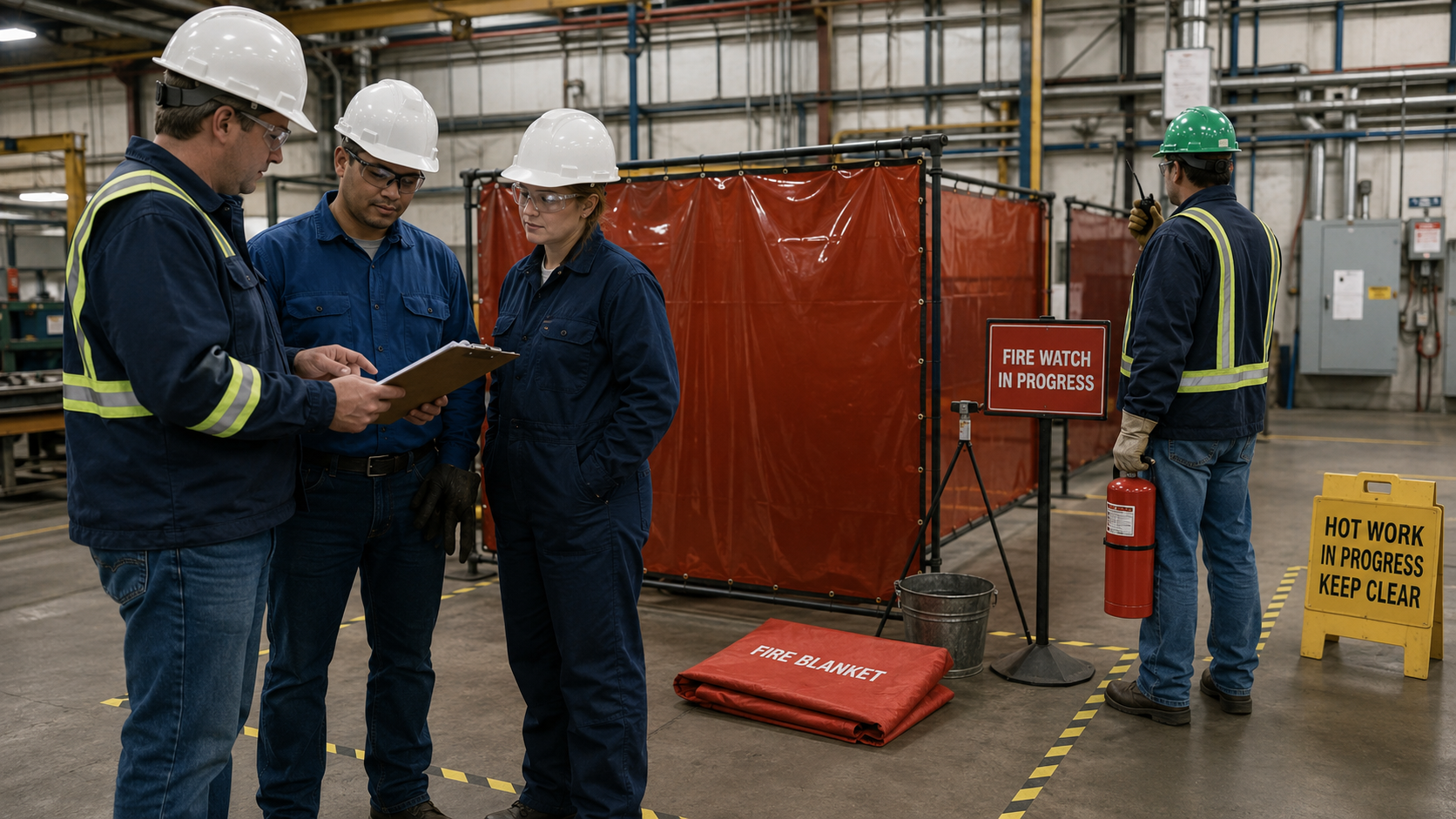
용접, 용단, 연마, 절단과 같은 화재위험작업은 작업 자체보다 작업 전 준비가 더 중요하다. 불꽃과 불티는 작업자가 보는 방향으로만 움직이지 않고, 틈새와 하부공간, 배관 주변, 적치물 뒤쪽으로 튀어 예상하지 못한 곳에서 발화 조건을 만들 수 있다. 따라서 화재위험작업 전에는 주변의 가연성·인화성 물질을 제거하고, 용접방화포나 불티 비산방지조치를 실시하며, 작업구역을 명확히 설정하는 과정이 선행되어야 한다.
관리감독자의 사전점검은 이 절차의 중심에 있다. 작업 전 안전조치가 실제로 이루어졌는지, 작업장 주변에 남아 있는 가연물이 없는지, 환기와 소화설비가 확보되어 있는지, 작업자가 확인해야 할 사항이 서면으로 게시되어 있는지를 확인하는 것은 형식적인 절차가 아니다. 이는 화재위험작업이 현장 조건을 충분히 통제한 상태에서 시작되도록 만드는 마지막 확인이다.
화재감시자 배치도 같은 맥락에서 보아야 한다. 화재감시자는 단순히 작업장 옆에 서 있는 사람이 아니라, 작업 중 불티의 비산, 주변 가연물의 변화, 작업 종료 후 잔류열과 지연발화 가능성까지 살피는 현장의 관찰자이다. 화재위험작업은 작업이 끝나는 순간 위험이 끝나는 것이 아니므로, 작업 후 확인까지 포함된 감시체계가 필요하다. 불티는 사라진 것처럼 보여도, 현장 어딘가에서는 아직 열을 품고 있을 수 있다.
화재위험작업의 안전은 허가서에 서명하는 순간 완성되지 않는다. 작업 전 제거, 작업 중 감시, 작업 후 확인이 연결될 때 비로소 관리된다.
Hot Work Requires Verification Before Permission
Hot work such as welding, cutting, grinding, and thermal cutting depends heavily on preparation before the work begins. Sparks and hot particles do not move only in the direction the worker can see. They can enter gaps, lower spaces, areas around piping, and spaces behind stored materials, creating ignition conditions in places that were not expected. Before hot work begins, combustible and flammable materials should be removed from the surrounding area, welding fire blankets or spark-containment measures should be applied, and the work boundary should be clearly established.
The supervisor’s pre-work inspection is at the center of this process. Confirming whether preventive measures have actually been implemented, whether combustible materials remain near the work area, whether ventilation and fire extinguishing equipment are available, and whether necessary safety information has been posted in writing is not a formal step. It is the final verification that hot work begins only after field conditions have been sufficiently controlled.
The assignment of a fire watch should be understood in the same context. A fire watch is not simply a person standing beside the work area, but an observer who monitors flying sparks, changes in nearby combustible materials, and the possibility of residual heat or delayed ignition after the work is finished. The risk of hot work does not disappear the moment the work stops, so a monitoring system that includes post-work confirmation is necessary. A spark may appear to be gone, while heat may still remain somewhere in the workplace.
Hot work safety is not completed when a permit is signed. It is managed only when removal before work, monitoring during work, and confirmation after work are connected.
비상조치는 사고 이후가 아니라 평상시에 완성된다
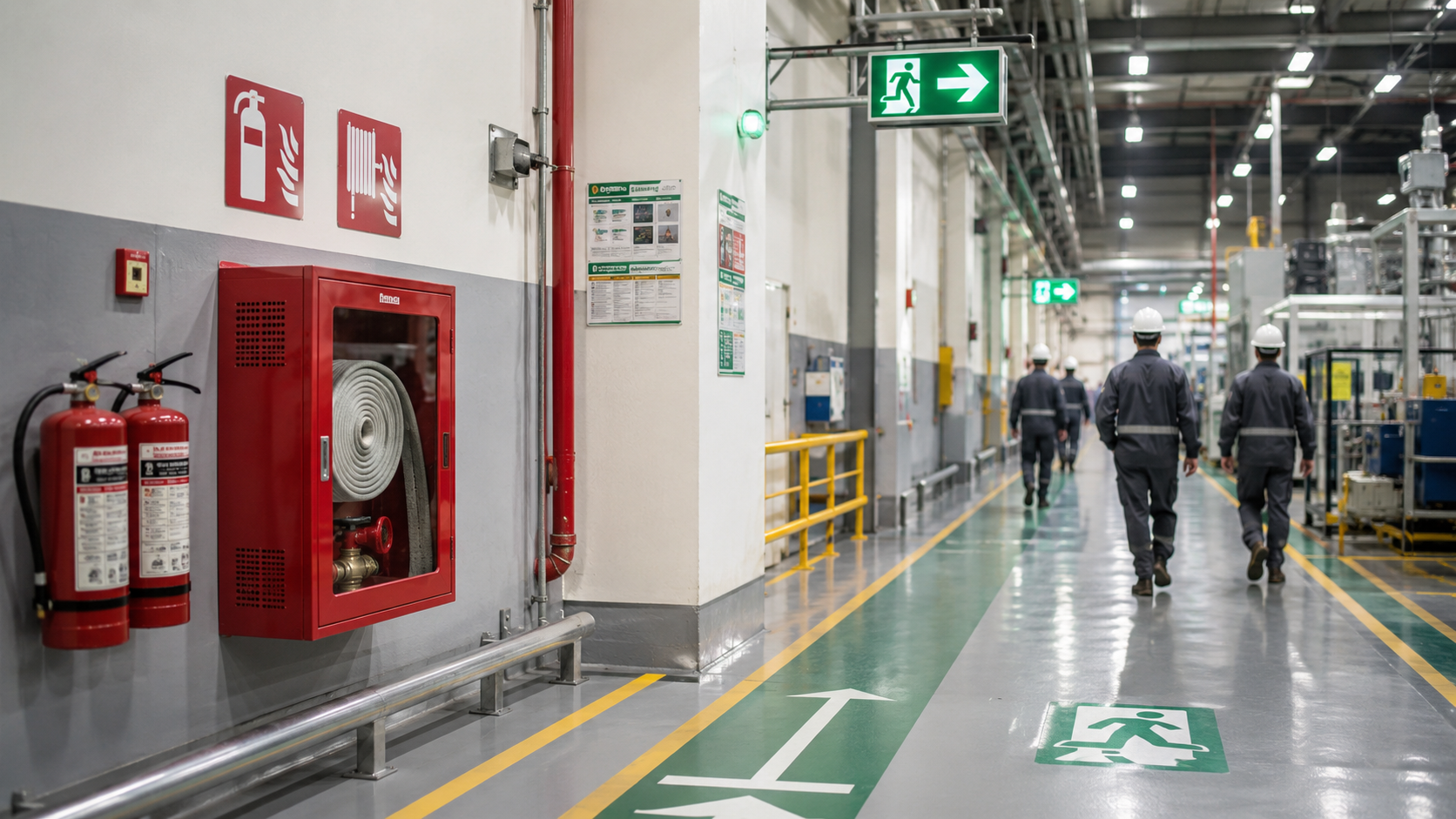
화재·폭발 예방에서 비상조치는 사고가 발생한 뒤에만 의미를 갖는 절차가 아니다. 비상통로가 확보되어 있는지, 비상대피시설이 정상적으로 관리되는지, 소화기와 소화설비가 필요한 위치에 설치되어 있는지, 비상대피훈련과 안전교육이 실제 현장동선에 맞게 이루어지는지는 평상시에 이미 결정되어야 한다. 사고가 발생한 순간에는 새로운 체계를 만들 시간이 없기 때문이다.
비상통로는 단순히 도면 위의 선이 아니라, 실제 사람이 이동할 수 있어야 하는 공간이다. 자재가 적치되어 있거나, 통로 표시가 불명확하거나, 비상구 주변이 작업물로 막혀 있다면 비상대피시설은 존재하지만 기능하지 않는 상태가 된다. 소화설비 역시 설치 여부만으로 평가할 수 없으며, 접근 가능성, 표시 상태, 점검상태, 사용교육 여부가 함께 확인되어야 한다.
화재예방 교육과 비상대피훈련은 현장을 기억하게 만드는 과정이다. 어느 방향으로 대피해야 하는지, 누가 화재를 알리고, 누가 초기소화를 시도하며, 어느 지점에서 집결하고, 화재위험작업 중 이상이 발생하면 어떤 절차로 작업을 중지할 것인지를 반복적으로 확인해야 한다. 훈련이 형식에 머물면 비상상황에서 사람은 익숙한 방향으로 움직이고, 익숙하지 않은 절차는 작동하지 않는다.
비상조치는 사고가 난 뒤 펼치는 매뉴얼이 아니라, 평상시에 몸에 익혀 두어야 하는 현장의 기억이다.
불씨를 키우지 않는 조직이 사고를 막는다
화재·폭발사고는 대개 하나의 원인으로 설명되지 않는다. 인화성 물질이 있었고, 환기가 충분하지 않았으며, 점화원이 분리되지 않았고, 전기설비가 관리되지 않았으며, 화재위험작업 전 확인이 부족했고, 비상조치가 현장과 따로 움직였을 때 사고의 조건은 점점 두꺼워진다. 그래서 화재·폭발 예방은 특정 장비 하나, 특정 작업자 한 명, 특정 점검표 한 장으로 완성되지 않는다.
자율안전점검표의 의미는 바로 여기에 있다. 점검표는 현장을 처벌하기 위한 목록이 아니라, 놓치기 쉬운 위험 조건을 순서대로 다시 보게 하는 도구이다. 인화성·가연성 물질, 점화원, 정전기, 전기설비, 화재위험작업, 화재감시자, 비상대피시설, 소화설비를 하나의 흐름으로 점검할 때, 현장은 사고 이후의 대응이 아니라 사고 이전의 예방으로 이동한다.
결국 화재·폭발 예방은 불이 난 뒤의 속도가 아니라 불이 나기 전의 태도에서 결정된다. 작업 전 한 번 더 측정하고, 통로와 물질을 한 번 더 분리하며, 전원을 한 번 더 확인하고, 불티가 닿을 곳을 한 번 더 살피는 조직은 사고의 가능성을 줄인다. 안전은 거창한 선언보다 반복되는 확인에 가깝고, 화재·폭발 예방은 그 확인이 현장의 습관으로 굳어질 때 가장 단단해진다.
불씨는 작을 때 꺼야 한다. 그러나 더 좋은 안전관리는 불씨가 생길 조건을 처음부터 만들지 않는 것이다.
Emergency Measures Are Completed Before the Emergency
In fire and explosion prevention, emergency measures are not meaningful only after an incident occurs. Whether emergency routes are secured, whether evacuation facilities are maintained properly, whether extinguishers and firefighting equipment are installed in the necessary locations, and whether evacuation drills and safety training reflect actual site movement routes must all be determined in ordinary times. Once an incident occurs, there is no time to create a new system.
An emergency route is not merely a line on a drawing. It is a space through which people must actually be able to move. If materials are stored in the route, if the route markings are unclear, or if the area around an emergency exit is blocked by work materials, the evacuation facility exists but does not function. Firefighting equipment also cannot be evaluated only by whether it has been installed. Accessibility, signage, inspection condition, and user training must all be checked together.
Fire prevention education and evacuation drills are processes that help the workplace remember. Workers must repeatedly confirm which direction to evacuate, who reports the fire, who attempts initial extinguishment, where people assemble, and what procedure stops work if an abnormal condition occurs during hot work. If training remains only a formality, people will move in familiar directions during emergencies, while unfamiliar procedures will not function.
Emergency measures are not manuals opened after an accident. They are workplace memories that must be learned in ordinary times.
Organizations That Do Not Let Sparks Grow Prevent Accidents
Fire and explosion incidents are rarely explained by a single cause. When flammable materials are present, ventilation is insufficient, ignition sources are not separated, electrical facilities are not managed, pre-work confirmation for hot work is weak, and emergency measures do not match the field, the conditions for an accident become increasingly dense. Fire and explosion prevention is therefore not completed by one device, one worker, or one checklist.
This is where the value of a self-inspection checklist becomes clear. A checklist is not a list for punishing the site; it is a tool that helps the organization look again, in sequence, at risk conditions that are easy to miss. When flammable and combustible materials, ignition sources, static electricity, electrical facilities, hot work, fire watch assignment, evacuation facilities, and firefighting equipment are checked as one connected flow, the workplace moves from post-incident response to pre-incident prevention.
Ultimately, fire and explosion prevention is determined not by the speed after a fire starts, but by the attitude before it starts. An organization that measures one more time before work, separates materials and routes one more time, confirms power one more time, and looks once more at where sparks might reach reduces the possibility of an incident. Safety is closer to repeated confirmation than to a grand declaration, and fire and explosion prevention becomes firmest when that confirmation becomes a habit of the workplace.
A spark should be extinguished while it is small. Better safety, however, prevents the conditions for that spark from forming in the first place.