작은 징후의 무게
중대재해는 조용한 경고를 지나 현실이 된다
하인리히 법칙은 숫자를 외우는 이론이 아니라, 현장이 반복해서 보내는 작은 신호를 어떻게 읽고 개선으로 연결할 것인가에 대한 질문이다.
The Weight of Small Signals
Serious Accidents Become Real After Quiet Warnings
Heinrich’s Law is not merely a numerical formula, but a practical question about how organizations read weak signals and turn them into prevention.
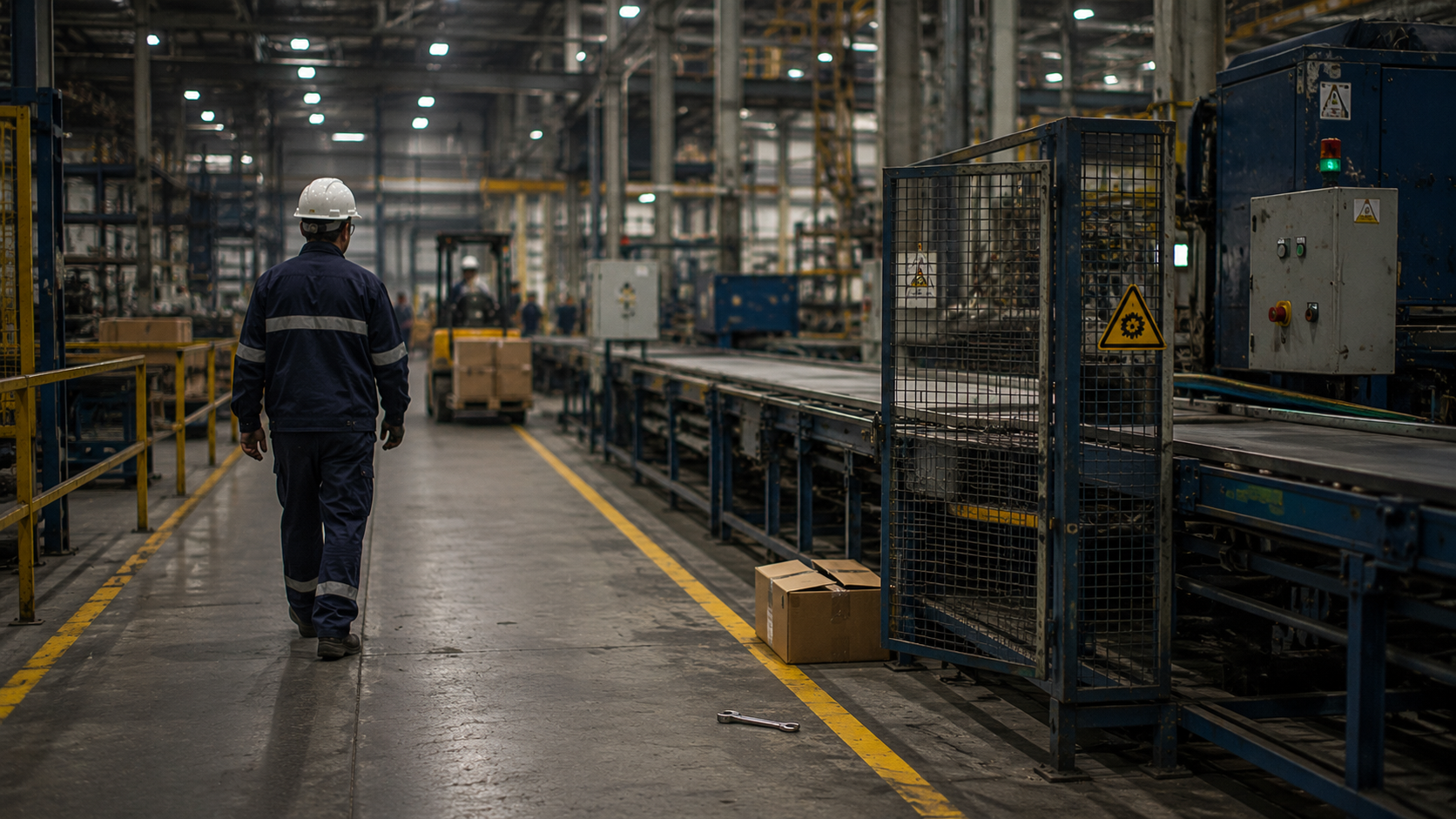
산업현장의 하루는 대개 익숙한 소리로 시작된다. 컨베이어가 낮은 진동음을 내며 움직이고, 지게차의 경고음이 통로 끝에서 짧게 울리며, 작업자는 정해진 동선을 따라 설비와 자재 사이를 오간다. 겉으로 보기에는 어제와 다르지 않은 평범한 장면이지만, 그 안에는 통로 가장자리에 놓인 작은 박스, 설비 가까이에 떨어진 공구, 잠시 열려 있는 방호커버처럼 사고로 이어질 수 있는 조건들이 조용히 섞여 있다.
문제는 이러한 장면이 너무 자주, 너무 익숙하게 반복된다는 데 있다. 누군가는 그것을 보고도 “이번에도 괜찮았다”고 넘기고, 누군가는 작업이 밀려 있다는 이유로 잠시 불편을 감수하며 지나가며, 또 다른 누군가는 위험을 느꼈지만 실제 사고가 발생하지 않았다는 이유로 보고하지 않는다. 그러나 안전관리에서 가장 위험한 순간은 큰 사고가 발생한 순간만이 아니라, 아무 일도 일어나지 않았다는 이유로 위험을 없었던 일처럼 받아들이는 순간이다.
사고가 없었다는 사실은 안전의 증거가 아니라, 위험이 아직 현실로 드러나지 않았다는 상태일 수 있다.
A typical day on an industrial site often begins with familiar sounds. A conveyor hums with a low vibration, a forklift warning tone briefly echoes from the end of an aisle, and workers move between equipment and materials along designated routes. At first glance, the scene may look no different from yesterday, yet small conditions capable of becoming accidents are quietly present: a box placed near the edge of a walkway, a hand tool left close to a machine line, or a guard cover that remains slightly open for just a little too long.
The problem is that these scenes are repeated so often that they begin to feel normal. Someone notices the condition but passes by because “nothing happened this time.” Another person accepts a minor inconvenience because production is busy, while someone else senses risk but does not report it because no injury occurred. In safety management, one of the most dangerous moments is not only the moment when a major accident happens, but also the moment when a risk is treated as if it never existed simply because no visible harm occurred.
The absence of an accident is not always proof of safety. It may only mean that a risk has not yet revealed itself as harm.
숫자가 말하는 것은 비율이 아니라 태도이다
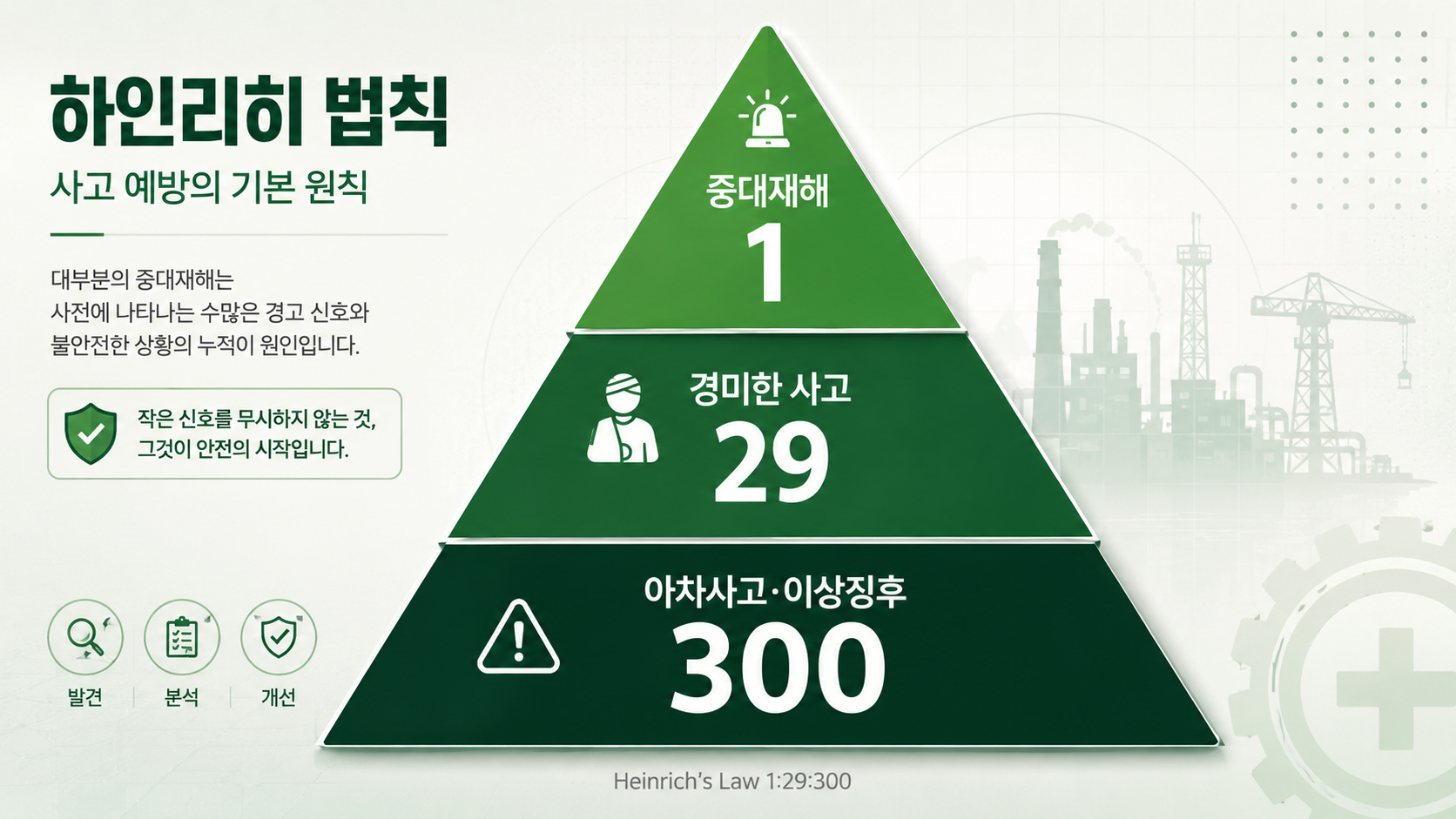
하인리히 법칙은 산업안전 분야에서 가장 널리 알려진 사고 예방의 언어 중 하나이다. 한 건의 중대한 재해 뒤에는 여러 건의 경미한 사고가 있고, 그보다 더 많은 수의 무상해 사고와 아차사고가 존재한다는 설명은 복잡한 안전관리의 본질을 매우 직관적으로 보여준다. 1:29:300이라는 숫자는 오늘날에도 교육자료와 안전회의에서 자주 언급되며, 작은 사고를 가볍게 보지 말아야 한다는 메시지를 전달하는 데 강한 힘을 가진다.
다만 이 숫자를 모든 사업장에 그대로 적용하는 것은 적절하지 않다. 업종마다 위험의 형태가 다르고, 공정마다 사고가 발생하는 방식이 다르며, 조직마다 아차사고를 보고하는 문화도 다르기 때문이다. 어떤 현장은 사소한 이상 징후까지 기록하지만, 어떤 현장은 작업자가 다치지 않으면 아무 일도 없었던 것처럼 넘어간다. 결국 하인리히 법칙의 핵심은 정확한 비율을 외우는 데 있지 않고, 중대재해가 어느 날 갑자기 떨어지는 우연이 아니라 반복된 작은 신호를 지나 현실이 된다는 관점에 있다.
현장에서는 작은 위험이 늘 작은 결과로 끝나지 않는다. 오늘은 통로에 놓인 상자를 피해 지나갔지만, 내일은 그 지점에서 시야가 가려질 수 있고, 오늘은 공구 하나가 바닥에 떨어진 채 지나갔지만, 다음 작업자에게는 넘어짐의 원인이 될 수 있다. 사고는 하나의 원인만으로 발생하지 않고, 미처 정리되지 않은 자재, 불명확한 동선, 급한 작업 지시, 익숙함에 의한 방심이 겹치면서 어느 순간 피해로 드러난다.
하인리히 법칙이 현장에 던지는 질문은 단순하다. 지금 보이는 작은 이상을 얼마나 진지하게 다루고 있는가.
무사고 기록이 위험을 가릴 때
사업장에서 무사고 기록은 분명 의미가 있다. 사고가 줄었다는 것은 작업자의 주의, 관리감독자의 관찰, 설비 개선, 교육과 점검이 일정 부분 작동하고 있다는 신호일 수 있다. 그러나 무사고라는 말이 현장을 지나치게 안심시키는 순간, 그것은 안전의 지표가 아니라 위험을 가리는 표현이 될 수 있다. 보고된 사고가 없다는 사실과 실제 위험이 없다는 사실은 결코 같은 말이 아니기 때문이다.
어떤 사업장은 아차사고 보고가 많으면 현장이 불안정하다고 생각한다. 보고 건수가 늘어나면 관리가 부족한 것처럼 보이고, 회의자료에 위험요인이 자주 등장하면 문제가 많은 사업장으로 비칠 수 있다고 우려한다. 그러나 안전관리의 관점에서는 오히려 반대로 볼 필요가 있다. 위험을 말할 수 있는 조직, 작은 불편을 기록하는 조직, 작업자가 느낀 순간적인 위화감을 관리자가 들을 수 있는 조직은 사고가 발생하기 전에 개입할 기회를 가진다.
반대로 아무런 보고가 없는 현장은 조용해 보이지만, 그 조용함이 안전을 의미한다고 단정할 수 없다. 작업자가 보고해도 달라지는 것이 없거나, 작은 사고를 말하면 개인의 부주의로 돌아오거나, 관리감독자가 개선 필요성을 제기해도 예산과 권한이 따라오지 않는 구조라면 현장은 점점 말하지 않는 방향으로 움직인다. 이때 무사고 기록은 실제 위험이 줄어든 결과가 아니라, 위험 정보가 조직 안에서 멈춘 결과일 수 있다.
침묵하는 현장이 안전한 현장은 아니다. 때로는 위험을 말하는 소리가 많은 현장이 더 건강한 안전문화를 가진다.
사람의 실수 뒤에는 작업의 구조가 있다
하인리히 법칙은 오랫동안 불안전한 행동을 줄이는 안전관리의 근거로 활용되어 왔다. 보호구를 착용하지 않았는지, 설비 정지 절차를 지켰는지, 통로를 벗어나 위험구역에 접근하지 않았는지를 확인하는 일은 여전히 중요하다. 그러나 현대의 안전관리는 여기서 한 걸음 더 들어간다. 작업자가 왜 정해진 절차를 지키기 어려웠는지, 왜 위험한 방법이 더 빠르고 쉬운 선택이 되었는지, 왜 같은 위치에서 반복적으로 지적사항이 발생하는지를 함께 살펴야 한다.
현장의 불안전한 행동은 개인의 성향만으로 설명되지 않는다. 작업공간이 협소하거나, 자재 적치 위치가 불명확하거나, 생산 흐름상 통로와 작업구역이 섞여 있거나, 설비 이상을 즉시 조치하기 어려운 구조라면 작업자는 결국 그 조건 안에서 가장 빠른 방법을 선택하게 된다. 겉으로는 개인의 판단처럼 보이지만, 실제로는 작업환경과 관리체계가 그 선택을 유도한 것일 수 있다.
예를 들어 작업자가 컨베이어 주변에 떨어진 물건을 제거하기 위해 설비 가까이 접근했다면, 단순히 “조심하지 않았다”고만 말할 수 없다. 해당 위치에서 이물질이 자주 발생하는지, 설비를 정지하지 않고 제거하려는 관행이 있었는지, 전용 도구가 제공되었는지, 작업 전 TBM에서 해당 위험이 공유되었는지를 함께 보아야 한다. 사고 예방은 사람을 탓하는 방식으로 완성되지 않고, 사람이 실수하더라도 사고로 이어지지 않도록 작업조건을 바꾸는 과정에서 완성된다.
안전관리의 초점은 누가 실수했는가에서 멈추지 않아야 한다. 왜 그 실수가 가능한 구조였는지를 보아야 한다.
The Numbers Point to an Attitude, Not a Fixed Ratio
Heinrich’s Law is one of the most widely recognized ideas in industrial accident prevention. Its basic message is intuitive: behind one serious injury, there are multiple minor injuries and far more no-injury incidents or near misses. The famous ratio of 1:29:300 is still often used in training sessions and safety meetings because it gives a powerful language to a simple but important principle: small incidents should not be dismissed simply because the visible result was minor.
However, the ratio should not be applied mechanically to every workplace. Different industries have different risk profiles, different processes produce accidents in different ways, and every organization has its own culture of reporting near misses. One site may record even small abnormalities, while another may treat a situation as if nothing happened unless someone was actually injured. The value of Heinrich’s Law is therefore not in memorizing the exact ratio, but in recognizing that serious accidents are rarely isolated surprises; they often emerge after repeated weak signals have been ignored.
In the field, small hazards do not always lead to small outcomes. A box placed near a walkway may be avoided today, but tomorrow it may block visibility or force a worker into an unsafe path. A hand tool left on the floor may go unnoticed during one shift, but become a trip hazard for the next worker. Accidents rarely arise from a single cause alone; they often appear when poor housekeeping, unclear traffic routes, time pressure, and familiarity with risk overlap at the wrong moment.
The question Heinrich’s Law asks is simple: how seriously does the organization treat the small abnormality it can already see?
When an Accident-Free Record Hides Risk
An accident-free record has real value. Fewer accidents may indicate that worker awareness, supervision, equipment improvement, training, and inspection are functioning to some degree. Yet when the phrase “no accidents” creates excessive confidence, it can become a screen that hides risk rather than a reliable indicator of safety. The absence of reported accidents and the absence of real hazards are not the same thing.
Some organizations believe that frequent near-miss reports make a workplace look unstable. More reports may appear to suggest weak management, and frequent discussion of hazards in meetings may be seen as evidence of a problematic site. From a safety-management perspective, however, the opposite may be true. An organization where people can speak about hazards, record small inconveniences, and share moments of discomfort with supervisors has more opportunities to intervene before harm occurs.
A workplace with no reports may look quiet, but that quietness should not automatically be interpreted as safety. If workers report hazards and nothing changes, if minor incidents return to individuals as blame, or if supervisors identify improvement needs without the budget or authority to act, the workplace gradually learns not to speak. In such a case, an accident-free record may reflect not the reduction of risk, but the interruption of safety information inside the organization.
A silent workplace is not necessarily a safe workplace. Sometimes a site with more visible risk conversations has a healthier safety culture.
Behind Human Error, There Is a Work Structure
Heinrich’s Law has long been used as a foundation for reducing unsafe behavior. It remains important to check whether workers wear personal protective equipment, follow equipment shutdown procedures, and avoid entering hazardous zones. Yet modern safety management goes one step further. It asks why a procedure was difficult to follow, why the unsafe method became faster or easier, and why the same issue continues to appear in the same location.
Unsafe behavior in the field cannot be explained only by individual attitude. If the workspace is narrow, material storage locations are unclear, traffic routes and work areas overlap, or equipment abnormalities cannot be corrected promptly, workers will often choose the quickest method available within those conditions. What appears to be an individual decision may actually be a decision shaped by the work environment and the management system.
For example, if a worker approaches a conveyor to remove an object that has fallen near the line, it is not enough to say that the worker was careless. The organization must ask whether foreign objects frequently occur in that location, whether there is a practice of removing them without stopping the equipment, whether proper tools are provided, and whether the risk was discussed during the toolbox meeting. Prevention is not completed by blaming a person; it is completed by changing work conditions so that even foreseeable mistakes do not easily become accidents.
Safety management should not stop at asking who made the mistake. It must ask why the mistake was possible within the work system.

작은 위험을 개선으로 연결하는 힘
작은 징후를 발견하는 것만으로 현장은 안전해지지 않는다. 중요한 것은 발견된 징후가 기록되고, 기록된 내용이 검토되며, 검토된 사항이 실제 개선으로 이어지는 흐름이다. 위험성평가, 순회점검, TBM, 관리감독자 점검, 근로자 의견 청취가 각각 다른 이름을 가지고 있지만, 결국 목적은 같다. 사고가 발생한 뒤 원인을 정리하는 것이 아니라, 사고로 이어지기 전의 조건을 먼저 찾아내는 것이다.
이 과정에서 관리감독자의 역할은 매우 중요하다. 관리감독자는 현장의 작업 리듬을 가장 가까이에서 보는 사람이며, 작업자가 왜 정해진 절차와 다른 방식으로 움직이는지, 어떤 위치에서 불편을 느끼는지, 어떤 설비가 반복적으로 작업자의 접근을 요구하는지를 직접 관찰할 수 있다. 따라서 관리감독자의 점검은 체크리스트에 표시를 남기는 행위에 그쳐서는 안 되며, 현장의 작은 변화를 읽고 개선 필요성을 조직에 전달하는 과정이어야 한다.
사업주의 역할도 여기에서 분명해진다. 작은 위험이 반복적으로 보고되는데도 개선이 지연된다면, 현장은 결국 위험을 정상상태로 받아들이게 된다. 반대로 통로 정리, 방호장치 보완, 작업절차 단순화, 보호구 비치, 설비 점검주기 조정처럼 작아 보이는 조치라도 빠르게 실행되면 현장은 위험을 말할 이유를 갖게 된다. 보고가 개선으로 이어지는 경험이 쌓일수록 작업자는 위험을 숨기지 않고 드러내며, 조직은 중대재해를 예방할 수 있는 정보를 더 많이 확보하게 된다.
작은 위험을 찾는 조직보다 더 중요한 것은, 찾은 위험을 실제 변화로 연결하는 조직이다.
Turning Small Risks Into Real Improvements
A workplace does not become safe simply because small signals are found. What matters is whether those signals are recorded, reviewed, and translated into actual improvement. Risk assessments, workplace patrols, toolbox meetings, supervisory checks, and worker consultations may have different names, but they share one purpose: to identify the conditions that may lead to an accident before the accident occurs.
In this process, the role of supervisors is critical. Supervisors are closest to the daily rhythm of work, and they can observe why workers move differently from written procedures, where workers experience inconvenience, and which pieces of equipment repeatedly require direct approach or intervention. Supervisory checks should therefore not be reduced to marking a checklist. They should function as a process of reading small changes in the field and communicating improvement needs to the organization.
The employer’s role also becomes clear at this point. If small risks are reported repeatedly but improvements are delayed, the workplace eventually accepts risk as normal. Conversely, when seemingly minor actions are taken quickly, such as clearing walkways, improving guarding, simplifying procedures, placing protective equipment properly, or adjusting inspection cycles, workers gain a reason to speak about risk. As the experience of reporting leading to improvement accumulates, workers become more willing to reveal hazards, and the organization gains more information with which to prevent serious accidents.
More important than finding small risks is building an organization that turns those findings into visible change.
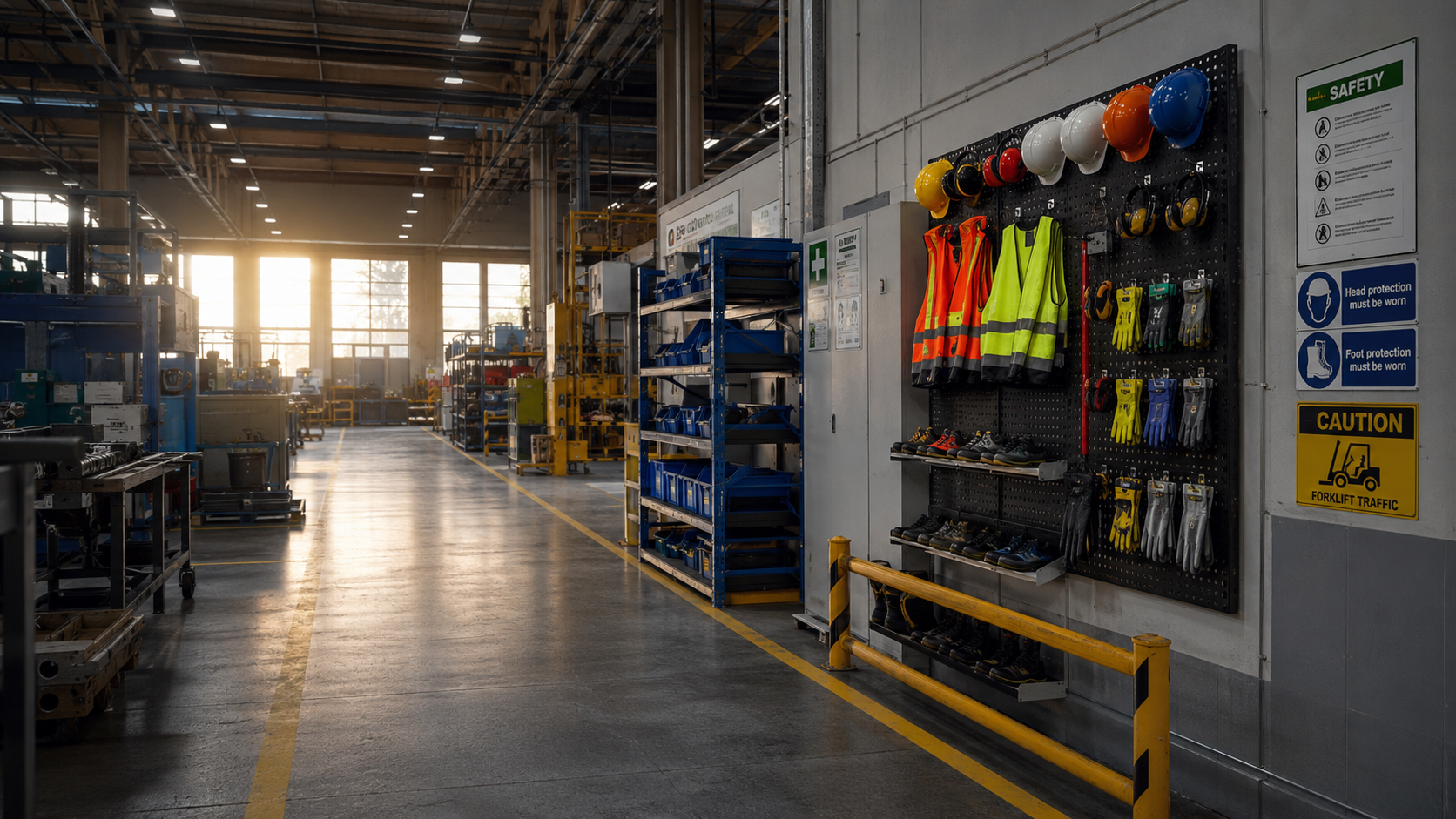
중대재해 예방은 일상의 감각에서 시작된다
중대재해 예방은 특별한 구호나 일회성 캠페인만으로 이루어지지 않는다. 그것은 통로에 놓인 작은 물건을 그냥 지나치지 않는 태도, 설비 주변의 불편한 동선을 반복된 문제로 보는 시선, 작업자가 느낀 아찔한 순간을 사소한 해프닝으로 넘기지 않는 문화에서 시작된다. 안전관리체계가 현장에서 힘을 가지려면 문서와 절차가 작업자의 실제 행동, 관리감독자의 관찰, 사업주의 개선 결정과 연결되어야 한다.
하인리히 법칙은 오늘의 현장에 하나의 경고를 남긴다. 큰 사고는 대개 아무런 신호 없이 나타나지 않으며, 그 이전에는 정리되지 않은 현장, 반복되는 아차사고, 보고되지 않은 불편, 개선되지 않은 지적사항이 존재한다. 물론 모든 작은 사고가 중대재해로 이어지는 것은 아니며, 모든 중대재해를 사전에 정확히 예측할 수도 없다. 그러나 예측이 어렵다는 이유로 작은 징후를 방치하는 것은 안전관리의 책임을 내려놓는 것과 다르지 않다.
결국 안전한 사업장은 사고가 한 번도 없었던 사업장이 아니라, 사고가 되기 전의 신호를 놓치지 않으려는 사업장이다. 작업자가 위험을 말하고, 관리감독자가 그 신호를 해석하며, 조직이 필요한 개선을 실행하는 흐름이 만들어질 때 중대재해는 우연의 영역에서 관리의 영역으로 들어온다. 작은 징후를 읽는 힘은 안전관리의 출발점이자, 현장을 오래 지키는 가장 현실적인 예방 전략이다.
중대재해 예방은 거대한 결단의 순간이 아니라, 사소해 보이는 위험을 매일 놓치지 않는 일상의 감각에서 시작된다.
Prevention Begins With Everyday Sensitivity
Preventing serious accidents is not achieved by slogans or one-time campaigns alone. It begins with the attitude of not walking past a small object placed in a passageway, the perspective of seeing an inconvenient equipment layout as a repeated problem, and the culture of not dismissing a worker’s moment of discomfort as a minor episode. For a safety and health management system to have real force in the field, documents and procedures must be connected to worker behavior, supervisory observation, and the employer’s decisions for improvement.
Heinrich’s Law leaves an important warning for today’s workplace. Serious accidents usually do not appear without any signal. Before they occur, there are often poorly arranged work areas, repeated near misses, unreported discomfort, and inspection findings that remain unresolved. Not every small incident leads to a serious accident, and no organization can perfectly predict every severe event in advance. Yet leaving small signals unattended because prediction is difficult is not different from giving up a core responsibility of safety management.
A safe workplace is therefore not simply a place where no accident has ever occurred. It is a place that tries not to miss the signals that appear before accidents happen. When workers speak about risk, supervisors interpret those signals, and the organization implements the necessary improvements, serious accidents move from the realm of chance into the realm of management. The ability to read small signals is the starting point of safety management and one of the most realistic strategies for protecting the workplace over time.
Serious accident prevention does not begin with a dramatic decision. It begins with the everyday sensitivity to notice risks that may look small.